

Confluence of Space Science and Educational Leadership
Sarabhai Institute of Science and Technology (SIST) stands upon a proud foundation established by India's foremost space scientists, launch directors, and research pioneers of the Space Engineers Welfare Society (SEWELS). Today, enhanced by the entrepreneurial governance of LEAD College (Autonomous), the institution harmonises national-level space engineering heritage with innovative professional pedagogy.
Dr. Vikram Sarabhai
12 August 1919 - 30 December 1971 | Father of the Indian Space Programme

Dr. Vikram Ambalal Sarabhai
Father of the Indian Space Programme
Founder of INCOSPAR, PRL, ISRO, TERLS & IIMA
Dr. Vikram Ambalal Sarabhai (12 August 1919 - 30 December 1971) was one of India's most distinguished physicists, visionary scientists and institution builders, widely recognised as the Father of the Indian Space Programme. Born in Ahmedabad, Gujarat, into a prominent family, he developed an early interest in science and research. He pursued his higher education at the University of Cambridge, United Kingdom, where he studied Natural Sciences and later conducted pioneering research on cosmic rays. He obtained his Ph.D. from Cambridge in 1947. Following his return to India, he established the Physical Research Laboratory (PRL) in Ahmedabad in 1947, which became a leading centre for research in space science and allied fields. His scientific vision, leadership and commitment to research played a significant role in shaping India's scientific and technological landscape.
Dr. Sarabhai recognised the immense potential of space technology in addressing national challenges and believed that scientific advancements should directly benefit society. In 1962, he established the Indian National Committee for Space Research (INCOSPAR), which laid the foundation for the Indian Space Research Organisation (ISRO), established in 1969. He played a pivotal role in developing India's space research infrastructure, including the establishment of the Thumba Equatorial Rocket Launching Station (TERLS) near Thiruvananthapuram, Kerala. The first sounding rocket was launched from Thumba on 21 November 1963, marking a historic milestone in India's space research journey. He envisioned the use of space technology for communication, education, weather forecasting, remote sensing and natural resource management, particularly to support the development of rural and underserved communities. His forward-thinking approach helped establish the foundation for India's future achievements in satellite technology and space exploration.
Apart from his pioneering work in space science, Dr. Sarabhai was a remarkable institution builder who believed that education, scientific research and innovation were essential for the progress of a nation. He played an instrumental role in establishing several prestigious institutions, including the Indian Institute of Management Ahmedabad (IIMA), Ahmedabad Textile Industry's Research Association (ATIRA), Vikram Sarabhai Community Science Centre and other scientific research organisations. He also served as Chairman of the Atomic Energy Commission from 1966 to 1971, contributing to the development of India's nuclear science and technology programmes. In recognition of his exceptional contributions, he received the Shanti Swarup Bhatnagar Award for Physics in 1962, the Padma Bhushan in 1966 and the Padma Vibhushan posthumously in 1972.
Dr. Vikram Sarabhai passed away on 30 December 1971 at Kovalam, Thiruvananthapuram, leaving behind an extraordinary legacy that continues to shape India's scientific and technological progress. His contributions are particularly significant to Kerala, where the Thumba Equatorial Rocket Launching Station became a landmark in the history of Indian space research. The Vikram Sarabhai Space Centre (VSSC), Thiruvananthapuram, was named in his honour, commemorating his vision and contributions. The Sarabhai Institute of Science and Technology (SIST) proudly carries his name, drawing inspiration from his ideals of scientific excellence, innovation, research and nation-building. The institution seeks to uphold these values by nurturing technically competent, socially responsible and innovative professionals who can contribute to the advancement of science, engineering and society.
Space Engineers Welfare Society (SEWELS)
Established in Thiruvananthapuram, Kerala by eminent space scientists and engineers
The Space Engineers Welfare Society (SEWELS) is a professional and educational society established in Thiruvananthapuram, Kerala, by a group of distinguished scientists, engineers and professionals associated with India's space research and engineering sectors. Inspired by their rich professional experience, technical expertise and commitment to societal development, the society was formed with the vision of promoting quality education, technological advancement and the welfare of society.
One of the significant milestones in the journey of SEWELS was the establishment of Sarabhai Institute of Science and Technology (SIST) at Vellanad, Thiruvananthapuram, in 2004. The institution was named in honour of Dr. Vikram A. Sarabhai, the Father of the Indian Space Programme, whose vision and contributions laid the foundation for India's achievements in space science and technology.
Through the establishment of SIST, SEWELS envisioned creating an institution that would impart quality technical education, encourage innovation and research, and nurture competent engineers with professional ethics and social responsibility. The society's association with eminent personalities from the space research and engineering fields reflects its commitment to academic excellence and technological progress.
Over the years, SIST has continued to contribute to the field of technical education by providing students with opportunities for academic learning, practical exposure, research and professional development. The institution's legacy is rooted in the vision and dedication of its founders, whose commitment to education continues to inspire its academic journey.
Leadership and Founding Members
SEWELS has been guided by experienced professionals who have made valuable contributions to India's space research and engineering sectors.

Dr. V. V. Karunakaran
President of SEWELS
Graduated with First Rank in Chemical Engineering, REC, Surathkal. As Head Application Development Division, VSSC & Dy. Proj. Director, Cryo Upper Stage Project, ISRO successfully developed various light weight foam systems and cryogenic insulation being used for launch vehicles and satellites.
Served as Principal, College of Engineering, Thrikaripur, Expert on Polyurethane Foam Polymer systems. Consultant - BMVSS, Jaipur for development of artificial limbs to handicapped, Technical Adviser and Consultant to Bhabha Atomic Research center. He is the President of SEWELS.

Mr. Koshy Mammen
Founder President & Vice President of SEWELS
Mr. Koshy Mammen was the founder President of SEWELS and is presently the Vice President of SEWELS. He graduated in Mechanical Engineering from College of Engineering, Thiruvananthapuram and took MBA. He joined the SLV Project under former President of India Dr A P J Abdul Kalam and then he moved to GSLV project where he was the Launch Campaign Manager.
He was Dy Project Director and the Recovery Team Leader in Space Capsule Recovery Experiment Project for which he received an award from the President of India. He worked as DGM/ROD-TERLS and has launched 5 Rockets in a day during 'sooryagrahan' in 2010 and got another award for this. He retired as Range Operation Director, Thumba Equatorial Rocket Launching Station.

Dr. K. Rajappa Kaimal
Secretary of SEWELS & Director of SIST
Graduated in Mechanical Engineering with distinction from REC, Surathkal and M S from IIT Chennai. Retired as DGM, TERLS after 33 years of service. Received prestigious National Award (NRDC, Govt of India) for the indigenization and invention of sophisticated slip rings for Radar.
Conferred 'Pride of India' and 'Glory of India' award, 2010 through All India Achievers' Forum. He has three patents to his credit. He is the spirit behind the college.
A Legacy of Vision, Knowledge and Excellence
The legacy of SEWELS represents the vision of experienced scientists and engineers who believed in the transformative power of education. Its contribution to the establishment of Sarabhai Institute of Science and Technology stands as a significant milestone in promoting technical education and empowering future generations of engineers.
LEAD College (Autonomous), Dhoni
A Legacy of Leadership and Excellence | Palakkad, Kerala
LEAD, an acronym for Leadership & Entrepreneurship Academy, Dhoni, is an educational institution located at Dhoni, Palakkad, Kerala. Established in 2010, LEAD began its journey with a vision of developing responsible leaders, innovative thinkers and successful entrepreneurs through quality management education.
Founded under the initiative of Dr. Thomas George, LEAD was envisioned as an institution that goes beyond conventional classroom learning by focusing on leadership development, entrepreneurship, professional competence and social responsibility. Its educational philosophy emphasises the development of knowledge, skills, attitudes and values essential for personal and professional excellence.
The institution's early journey reflects a remarkable story of determination and commitment. Starting with 120 students, LEAD faced regulatory challenges during its initial years. However, 58 students continued to believe in its vision. Demonstrating its commitment to its students, the institution supported them by providing free education, food and accommodation. These students became the first graduates of LEAD in 2012, marking a significant milestone in its history.
Over the years, LEAD has grown into a recognised institution for management and professional education. Its journey has been marked by important achievements, including AICTE approval, NAAC accreditation, NBA accreditation, ISO 21001:2018 certification and autonomous status under the University of Calicut.
Today, LEAD College (Autonomous), formerly known as LEAD College of Management, continues to uphold its founding vision through its MBA and MCA programmes, industry-oriented learning, experiential education and emphasis on holistic student development.
The legacy of LEAD represents perseverance, entrepreneurial spirit and a commitment to transforming individuals into capable leaders. Its journey from a small group of determined students to an autonomous institution stands as a testament to its vision of shaping futures through education, leadership and innovation.
Autonomous
Univ. of Calicut
NAAC
Accredited
NBA
Accredited
ISO 21001:2018
Certified
AICTE
Approved
Dr. Thomas George (Thomman)
Director of LEAD College | Entrepreneur, Educator & International Trainer
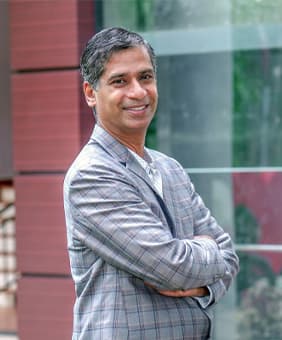
Dr. Thomas George (Thomman)
Director of LEAD College
In 1994, three decades back, Dr. Thomas started his professional career as an entrepreneur of a start-up computer firm called Prompt Computers, which mainly dealt with the sales and service of computers and accessories in Palakkad. Prompt Computers has developed India's largest touch screen network for Indian Railways.
Later in 2002 he chose to be a soft skill trainer focusing his attention mainly among the youth and students. Then as the time passed by, he became an "International Trainer" of JCI wherein he has visited more than 35 countries for training.
Entrepreneurial Pioneer
Founded Prompt Computers in 1994; developed Indian Railways largest touch screen network.
International JCI Trainer
Trained youth and corporate professionals across more than 35 countries worldwide.